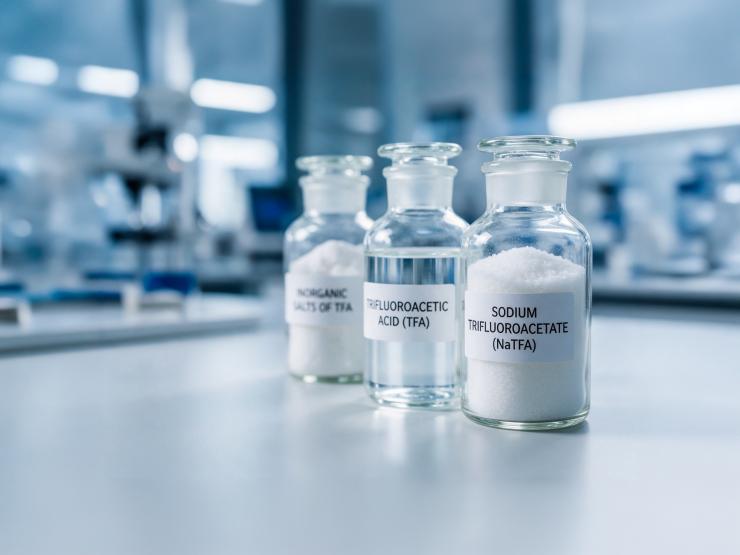
The European Chemicals Agency's (ECHA) Committee for Risk Assessment (RAC) has adopted an opinion recommending new harmonised classifications for trifluoroacetic acid (TFA), sodium trifluoroacetate (NaTFA), and other inorganic salts of TFA. These recommendations have now been forwarded to the European Commission (EC) for consideration.
Proposed Classifications for TFA, NaTFA & Other Inorganic TFA Salts
RAC recommends classification as:
- Reproductive Toxicity Category 1B for adverse developmental effects;
- Reproductive Toxicity Category 2 for adverse effects on sexual function and fertility;
- Persistent, Mobile and Toxic (PMT); and
- Very Persistent and Very Mobile (vPvM), reflecting the potential for long-lasting and widespread contamination of water resources.
Additional Classifications Proposed for TFA Only
For TFA specifically, RAC also recommends classification as:
- Acute Toxicity (Oral) Category 4, with an acute toxicity estimate (ATE) of 500 mg/kg body weight; and
- Acute Toxicity (Inhalation, Vapours) Category 3, with an ATE of 3 mg/L.
Why New Hazard Classifications for TFA?
TFA is highly soluble in water. Whether present as TFA itself or as one of its inorganic salts, it rapidly dissociates in aqueous environments, meaning that the trifluoroacetate anion is the species predominantly present alongside the corresponding hydrogen or inorganic cation.
A strong synthetic acid, TFA has a range of laboratory and industrial applications. Information submitted under EU REACH indicates its use:
- As an intermediate in the manufacture of fine chemicals;
- In pharmaceutical production;
- As a solvent; and
- In surface treatment applications.
In parallel, increasing attention is being given to TFA as an environmental degradation product of several fluorinated substances, including certain PFAS, F-gases, and active substances used in biocidal and plant protection products.
What's Next for TFA Classification?
The European Commission typically requires between three and nine months to evaluate a final RAC opinion. Based on this timeline, a draft Adaptation to Technical Progress (ATP) updating the harmonised classification of TFA, NaTFA and other inorganic TFA salts could be published during the first half of 2027.
Following publication, the proposal will be considered by the REACH/CLP Committee. If adopted, an implementation period of approximately 18 months would normally apply before the new classifications become legally binding.
If the proposed classifications are ultimately adopted, TFA and its inorganic salts could also become candidates for identification as Substances of Very High Concern (SVHCs). This would represent the first step towards potential inclusion in the REACH Authorisation process, introducing additional regulatory obligations for affected supply chains.
TFA's Connection to the PFAS Restriction Proposal
TFA meets the EU definition of a PFAS and is therefore within the scope of the proposed Universal PFAS Restriction currently under evaluation. The restriction proposal is in the final stages of RAC assessment, with a draft opinion expected later this year.
The RAC opinion on TFA therefore represents another significant regulatory development for fluorinated substances and may have important implications for manufacturers, importers and downstream users across multiple sectors.
If you have any regulatory questions regarding TFA, NaTFA or any inorganic TFA salts, please call or email and speak directly with our team of specialist chemical regulatory consultants.