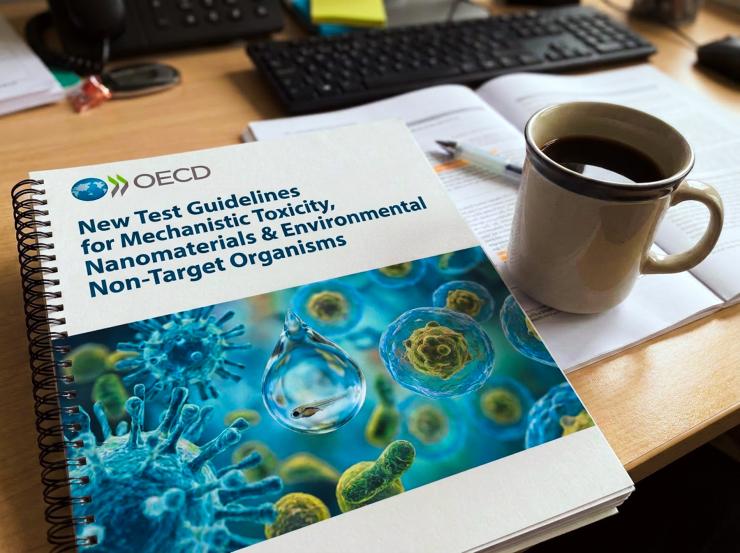
The OECD has published seven new test guidelines covering physico-chemical properties, effects on biotic systems, environmental fate and behaviour, and human health effects. Dated 2 July 2026, these additions expand the OECD's internationally recognised suite of safety testing methods and further support the organisation's Mutual Acceptance of Data (MAD) system.
Together, the guidelines highlight three key trends in method development:
- Mechanistic toxicology continues to gain momentum, with internationally harmonised in vitro methods moving beyond hazard identification to provide greater insight into biological pathways and modes of action.
- Addition of further dedicated nanomaterial guidelines reflects continued maturation of regulatory approaches for advanced materials.
- New higher-tier ecotoxicology methods strengthen environmental protection for cornerstone species.
Below is a brief overview of each new guideline. Future articles will further explore their scientific applications, strengths and potential limitations.
Three New In Vitro Guidelines Strengthen Mechanistic Toxicity Assessment
Test No. 454A: Human Glucocorticoid Receptor Transactivation Assay
The first OECD in vitro method designed to identify agonist and antagonist activity at the human glucocorticoid receptor, which regulates key physiological processes including stress responses, inflammation, metabolism and immune function. This assay provides the first OECD-recognised approach for investigating glucocorticoid receptor-mediated activity. Glucocorticoids represent a family of hormones that effect the endocrine system through non-EATS modalities. With the need to conclude on endocrine disruption as a new hazard class under CLP in force, investigating such modalities not only represents a challenge but a critical regulatory need. This is especially the case as non-EATS endocrine mechanisms are receiving increasing attention; it will be interesting to understand the future application of this test guideline in ED assessments, how it supports hazard conclusions and if its utility leads to widespread adoption.
Test No. 445A: Determination of Cytochrome P450 (CYP) Induction Using Differentiated Human Hepatic Cells
This guideline uses metabolically competent human-derived hepatic cells to assess whether chemicals induce three key Phase I biotransformation enzymes: CYP3A4, CYP1A2 and CYP2B6. These enzymes play central roles in the metabolism of xenobiotics and the biosynthesis of endogenous compounds, including steroid hormones. Although CYP induction studies are already commonly used outside formal test guidelines, particularly when investigating liver-mediated mechanisms relevant to endocrine activity, to expand toxicokinetic understanding or to support read-across, this OECD guideline provides an internationally harmonised approach for generating mechanistic data.
Test No. 446A: ToxTracker Gene Reporter Assay for the Identification of Genotoxic Hazard and Genotoxic/Non‑Genotoxic Mechanism of Action
An in vitro stem cell-based assay designed to establish genotoxic properties and distinguish between direct DNA damage and indirect, cytotoxicity-driven stress responses. This provides valuable mechanistic insight without the use of multiple assays.
Two New Guidelines Support the Assessment of Nanomaterials
Test No. 322: Determination of the Solubility and Dissolution Rate of Nanomaterials for Environmental Fate Assessment
Provides recommended methods for determining the dissolution behaviour and dissolution rate of nanomaterials under environmentally relevant pH using passive pH control (buffers). The guideline adopts a two-part approach consisting of a simple batch test and an extended time-resolved batch test.
Test No. 127: Dustiness Determination of Materials Containing Nano‑Objects and Their Aggregates and Agglomerates
This guideline measures the propensity of powders and fine solid materials to generate airborne dust. It addresses the need for standardised dustiness testing methods for materials containing granular or fibrous nano-objects and their aggregates and agglomerates (NOAA), supporting more consistent exposure assessment.
Both guidelines support critical decision making in a regulatory context, as the test results can be used to support exposure assumptions and the most appropriate testing program.
Two New Guidelines that Expand Ecological Testing for Non-Target Organisms
Test No. 256: Determination of Effects on Earthworms (Oligochaeta, Annelida) in Field Studies
This field-based method enables the assessment of chemical effects on earthworm populations under environmentally realistic conditions, complementing existing laboratory ecotoxicity studies and providing higher-tier data for environmental risk assessment.
Test No. 255: Bumblebee (Bombus spp.), Chronic Oral Toxicity Test (10‑Day Feeding)
OECD TG 255 introduces a standardised chronic oral toxicity study for bumblebees, providing important data for assessing long-term risks to pollinators. The guideline reflects growing regulatory interest in protecting non-Apis pollinator species and strengthening pollinator risk assessments for plant protection products.
Blue Frog provides expert support to clients for genetic toxicity, endocrine disruption, nanomaterials and agrochemicals. If you'd like to discuss any of these new guidelines in more detail or have queries relevant to these topics, call or email and speak directly with one of our regulatory specialists in toxicology & human health assessment, ecotoxicology & environmental health or nanomaterials.